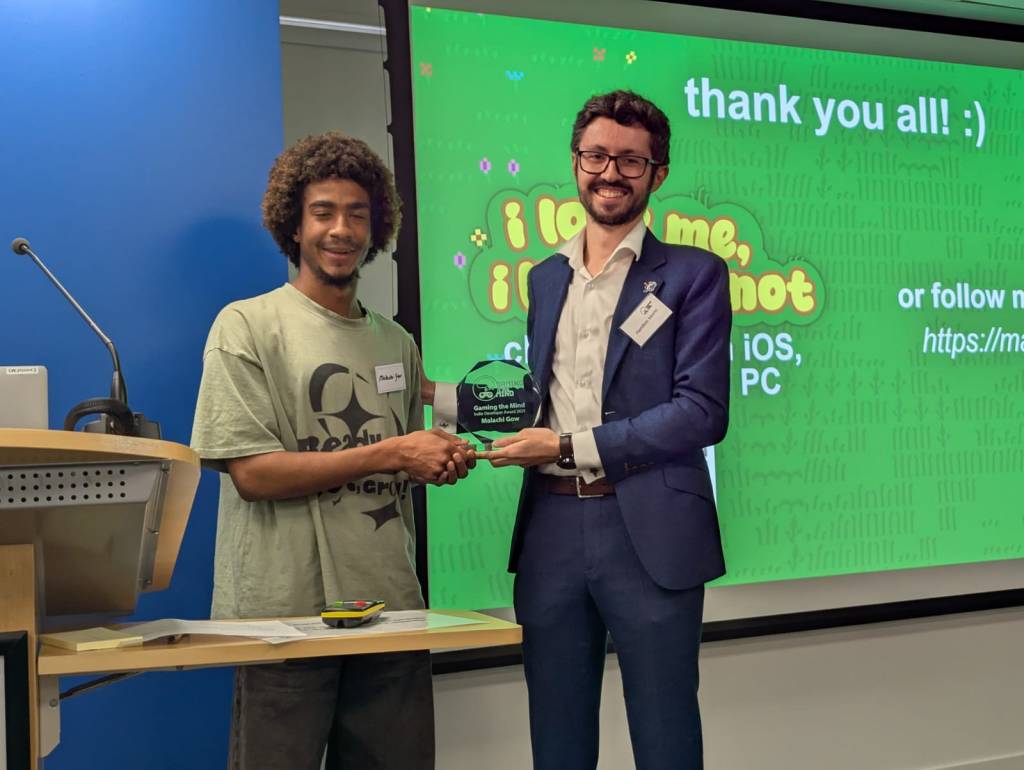
At the first ever Gaming the Mind Conference, we were delighted to award Malachi Gow with the inaugural Independent Developer Award. His game “i love me, i love me not” is described as “a hand-drawn mental-health focused game where you’ll play as a sunflower whose petals — representing aspects of their identity — have withered away. You’ll wander, explore and meet new friends around this beautiful flower field, each teaching you a healthy habit, helping you grow yourself back together again!”
We caught up with him about his journey in making the game.

GTM: How did you get into game development?
Malachi: I see myself as a creative. I yearn for expression and exploration and the way I pursue these desires is through the development of my projects and games. It’s where I feel most at home.
Throughout my life, this has always been the case: I’d gravitate towards games that allowed you to create your own levels, or had some level of customisation, allowing players to add a little of their own imagination. This fire and passion grew larger as I got older.
I started to enjoy developing projects that were absurd or different; something that conveys part of my character. I’d also use my projects as a way to tell an audience a story, while hiding hints of myself in there. Just like artists explore ideas of themselves through art, I use the art of game development to do the same.
GTM: What was the inspiration for “i love me, i love me not”?
Malachi: The game originated from an onboarding task for my placement year at Unity Technologies. I was free to make any sort of game, so I chose a project I could use as a canvas to express a part of my inner mind, my struggles, and how/why I seek resolution. I wanted to challenge myself to create something different, and to grow by doing so. This is what I value most in my game development journey: learning skills by seeking change.
Months before the actual development started, the idea for the game was formed through a collection of media. Generally, when coming up with ideas for projects, I take from everything I connect with that leaves a lasting impact on me, as I desire to create the same impact for others.
The main inspiration that initially sparked my imagination for the game was a TikTok by @artbells, showing an uplifting conversation between two sunflowers, one of which was withering. I loved the symbolism of using petals to signify health and growth.
Another huge inspiration for the game was a mental-health-focused app called “Worrydolls“. A friend showed me how she’d use the app to support mental health in an interactive manner, which is the same purpose of “I luv me, i love me not”.
GTM: What did you personally bring to this game?
Malachi: It is a canvas I use to creatively explore the mind, essentially acting as an extension of myself; a shout into the void for the world to see. The game doesn’t quite fit the mould of other projects I’ve developed, meaning I’m free to define standards and invent new ideas I can’t within anything else.
GTM: How would you like players to experience the game?
Malachi: I hope others can find some comfort in the game, both from its idea and execution. Mental health is a tricky topic; no umbrella is big enough to cover how all our minds work. Nevertheless, I wanted to at least try through the vision of this game to help others in a few ways. I want to share my own practices, and help others build their own. I want to spread a little light and joy, to try and brighten someone’s day. Finally, I hope I’ve created an interactive yet digestible experience, so that least a part of it can stick with the player.
GTM: What’s next for “i love me, i love me not” and beyond?
Malachi: As I improve my skills throughout my journey, I will be polishing the game; adding in new music, drawing more illustrations, developing fitting systems such as weather & seasons, and creating in-game events.
I have a lot of ideas planned that I’d love to explore. I’ve been heavily inspired by projects such as “Kind Words”, “The Unsent Project”, and “we’re not really strangers”, and so I’m curious as to how I could incorporate some of their concepts into my own.
For example, I’d love to implement some sort of online functionality, allowing players to create and exchange positive notes/messages with the world. This would be in the form of sharing poetry, love letters, wishes, and aspirations. I’m ambitious to provide the player with the means to branch out a little and give them their own platform to express their inner minds.
Find out more about “i love me, i love me not” here.
 Gaming the Mind
Leave a comment